


Imagine this: It’s Friday evening, and your team is wrapping up the week. Spirits are high, but there’s one thing on everyone’s mind: payday!!
Ensuring your employees receive their hard-earned wages accurately and on time isn’t just a legal obligation; it’s also a basic ethic. Whether running a small business or part of a large corporation, getting payroll right is essential for maintaining employee morale and staying compliant with UK regulations. But payroll isn’t just about numbers on a payslip; it’s about trust, transparency, and keeping everyone on the same page.
In this guide, we’ll explore what payroll means in the UK, the nuts and bolts of getting it right, and even point you toward experts who can make your life a whole lot easier. So, grab a cup of tea, settle in, and let’s get started.
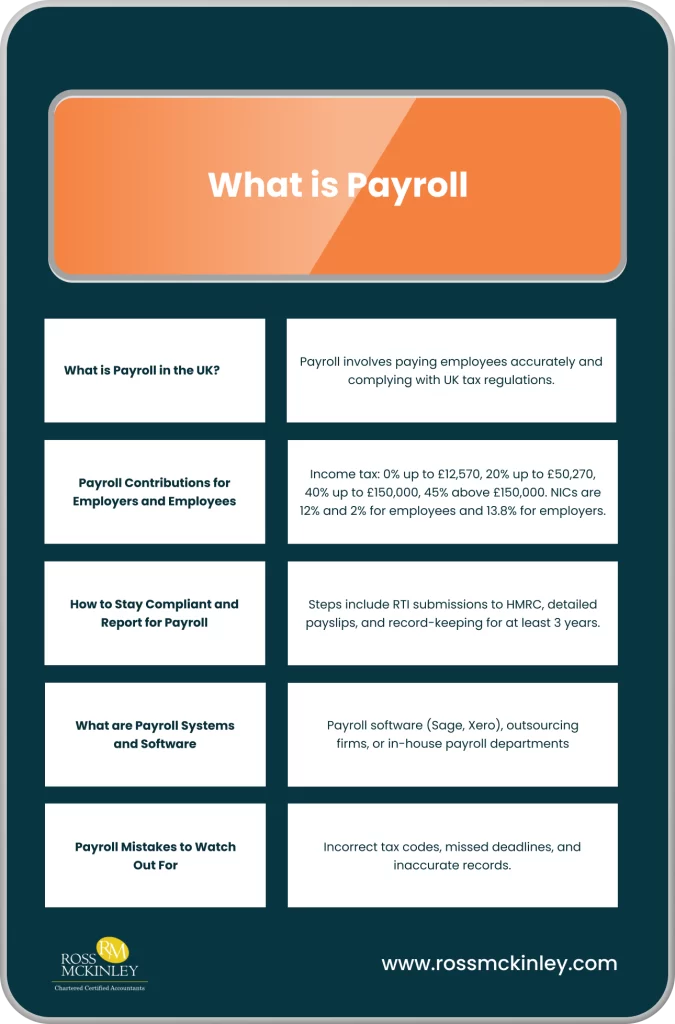
Table of Contents
How Does Payroll Work?
Payroll is the process of calculating and disbursing employees’ wages, but its significance goes beyond just paying salaries. In the UK, it’s not just about handing out cheques or transferring funds.
It plays a crucial role in the smooth functioning of an organisation and ensures compliance with legal obligations.
Payroll is a multi-step process that involves calculating wages, deducting taxes, and making sure everyone gets paid on time. Here’s what your payroll typically includes:
- Calculating gross wages
This is the total amount your employees earn before any deductions. Think of it as the “before” picture, and the net pay is the “After” Picture.
- Deductions and contributions
This is where things get complicated. You’ll need to deduct income tax, National Insurance, pension contributions, and maybe even student loan repayments.
- Paying your employees
Once all the deductions are made, it’s time to pay your employees. This can be done via direct deposit or cheque.
- Reporting to HMRC
You’ll need to submit Real Time Information (RTI) to HMRC, which is your formal way of saying, “Hey, we paid our employees, and here’s how much tax we took out.”
- Keeping records
Keeping records is a must because if HMRC comes knocking, you’ll want to have all your ducks in a row.
Payroll Contributions for Employers and Employees
Payroll calculations might seem complicated at first, but understanding the basics makes it much easier. These contributions form the backbone of the UK’s employment and tax system. Here’s a breakdown of key contributions and who pays what:
- Income Tax
Deducted through the Pay As You Earn (PAYE) system, where the employer withholds tax on behalf of HMRC. The amount depends on the employee’s tax code and earnings.
Deductions are 0% for earnings up to £12,570 (Personal Allowance), 20% for earnings between £12,571 and £50,270 (Basic Rate), 40% for earnings between £50,271 and £150,000 (Higher Rate), and 45% for earnings above £150,000 (Additional Rate).
- National Insurance Contributions (NICs)
Both employees and employers contribute. For the 2023/24 tax year, employees pay 12% on earnings between £242 and £967 per week and 2% on earnings above that. Employers pay 13.8% on earnings above £175 per week.
- Pension Contributions
With auto-enrolment, employers must enrol eligible employees into a pension scheme and make contributions. The minimum contribution is 8% of qualifying earnings, with at least 3% coming from the employer.
- Student Loan Repayments
If applicable, deductions are made based on the employee’s earnings and repayment plan. For Plan 1 loans, 9% is deducted on earnings above £22,015 annually; for Plan 2, 9% on earnings above £27,295.
- Other Deductions
This can include things like child maintenance payments or salary sacrifice schemes. Each of these requires careful calculation to ensure accuracy and compliance.
How to stay compliant and Report for payroll
The UK has stringent regulations when it comes to payroll. Ensuring payroll compliance is essential for every UK business. Staying on top of these requirements not only avoids penalties but also builds trust with your workforce. Employers are obligated to:
- Register as an Employer
Before hiring, businesses must register with HMRC to get a PAYE reference number.
- Real-Time Information (RTI) Submissions
Every time employees are paid, employers must submit details to HMRC on or before the payday.
- Provide Payslips
Employees must receive a detailed payslip showing earnings and deductions.
- Maintain Records
Payroll records must be kept for at least three years, including details of payments, deductions, and RTI submissions.
What are Payroll Systems and Software
Handling payroll manually can quickly become overwhelming as a business expands. Fortunately, there are smart solutions to make the process smoother and more efficient. The key is finding the approach that fits your company’s size, budget, and specific requirements.
- Payroll Software
Payroll software automates calculations, deductions, and RTI submissions. Some of the examples include Sage, QuickBooks, and Xero.
- Outsourcing
Many businesses opt to outsource their payroll to specialized firms, ensuring compliance and freeing up internal resources.
- In-House Teams
Larger organisations might have dedicated payroll departments to handle the complexities involved.
Pros and Cons of Outsourcing Payroll
Even with the best intentions, payroll cons can sneak in and cause major business headaches. The good news? These cons are avoidable, and the pros of outsourcing payroll are here to the rescue. Using the wrong tax code might leave employees paying too much or too little tax while missing important deadlines for RTI submissions can result in costly penalties.
Keeping your payroll team trained on the latest regulations, double-checking entries for accuracy, and investing in reliable payroll software with regular updates can save time, money, and stress. Here’s a quick roundup of the pros and cons of outsourcing payroll.
| Pros | Cons |
| Expert Compliance – Ensures adherence to tax laws and regulations. | Loss of Control – Less oversight over payroll processing. |
| Reduced Stress – Eliminates payroll complexities and administrative burdens. | Potential Communication Delays – Dependence on external providers may slow response times. |
| Access to Advanced Technology – Uses cutting-edge payroll software and automation. | Security Concerns – Sharing sensitive payroll data with a third party increases risk. |
| Scalability – Easily adapts to business growth and workforce changes. | Less Flexibility – Customizing payroll processes may be limited by provider constraints. |
Why Choose Ross McKinley for Your Payroll Needs?
Navigating the complexities of UK payroll can be challenging, but you don’t have to do it alone. Ross McKinley offers comprehensive payroll services tailored to your business needs. With over 46 years of combined experience, our team ensures accuracy, compliance, and efficiency in managing your payroll.
Trust us to handle the intricacies of payroll so you can focus on what you do best—growing your business.
Conclusion
In the UK, payroll is more than just paying employees; it’s about mastering regulations, crunching accurate numbers, and staying on top of reporting deadlines. When done right, it becomes a powerful tool that boosts employee trust and keeps your business running smoothly.
By staying informed and leveraging smart resources, businesses can simplify payroll, stay compliant, and create a positive work environment where everyone wins. After all, getting payroll right isn’t just a task, it’s a step toward business success.