


How Do I Set up Payroll?
Imagine this: It’s Friday evening, and your team is wrapping up the week. Spirits are high, but there’s one thing on everyone’s mind: payday!! Ensuring your employees receive their hard-earned wages accurately and on time isn’t just a legal obligation; it’s also a basic ethic.
Whether running a small business or part of a large corporation, getting payroll right is essential for maintaining employee morale and staying compliant with UK regulations. But payroll isn’t just about numbers on a payslip; it’s about trust, transparency, and keeping everyone on the same page.
In this blog, we’ll walk you through how to set up a payroll system that works for your business. We’ll cover everything from registering yourself as an employer, calculating wages to handling taxes and staying compliant with HMRC.
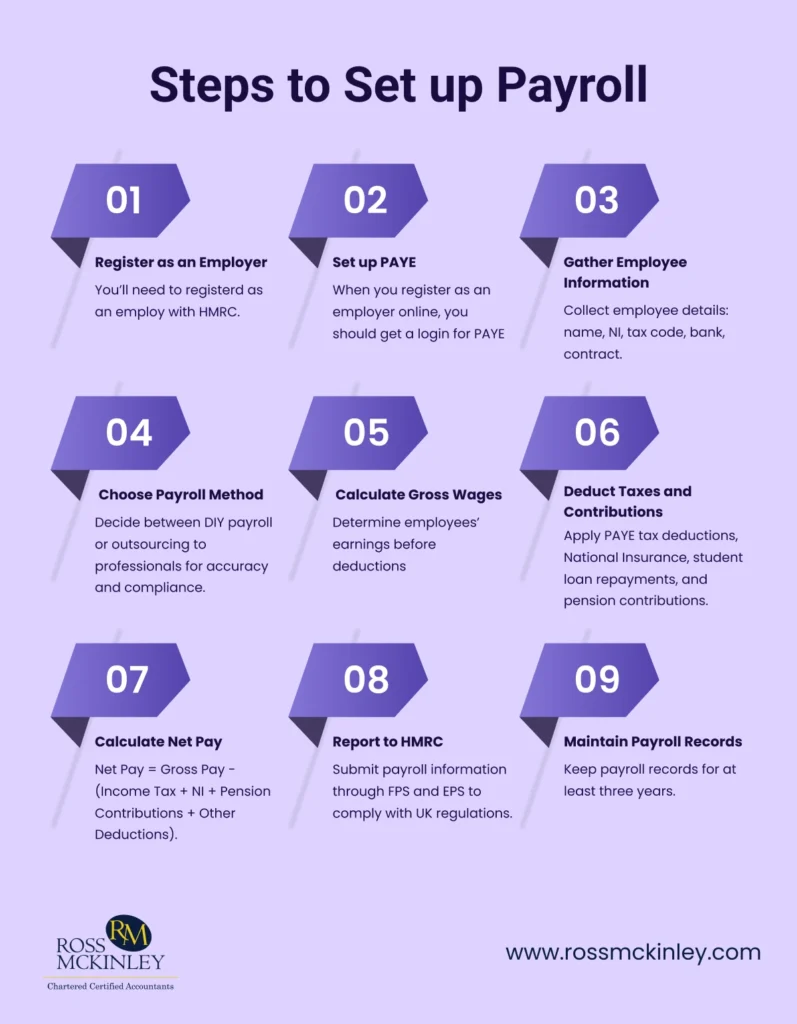
Table of Contents
How Do I Set up Payroll?
Before we get into the nitty-gritty, let’s start with the basics. Payroll is the process of calculating and disbursing employees’ wages, but its significance goes beyond just paying salaries. In the UK, it’s not just about handing out cheques or transferring funds. It plays a crucial role in the smooth functioning of an organisation and ensures compliance with legal obligations
Payroll is a multi-step process that involves calculating gross wages, deducting taxes and contributions, reporting to HMRC, and making sure everyone gets paid on time.
Steps to Set up Payroll
Payroll isn’t just about handing out money. It’s about accuracy, compliance, and making sure your employees feel valued. Mess it up, and you could be facing fines, penalties, and some very unhappy team members. For your feasibility, Ross McKinley has outlined major steps to streamline your process of setting up your payroll.
Register as an employer
Before you start paying your employees, you’ll need to register as an employer with HMRC. This is how you get your PAYE number, which needs to be included on employee payslips.
Just be aware that it can take up to five days to get your employer PAYE reference number and you’ll only be able to register within two months before you start to pay your employees.
Set up PAYE
When you register as an employer online, you should get a login for PAYE. However, if you registered as an employer some other way and didn’t receive your login information, you will have to enrol for PAYE online separately.
Gather Your Employee Information
Gathering all the necessary information about your employees is a must while setting up payroll. Which includes the employee’s Full Name, Address, National Insurance Number, Tax Code, Bank Details, and Employment Contract.
DIY payroll or Outsource
When it comes to payroll, business owners have two main options: handling it themselves or outsourcing it to professionals. DIY payroll might seem cheap at first, but it comes with compliance risks and time-consuming calculations. Even a small mistake, like using the wrong tax code or missing an RTI submission, can lead to hefty penalties.
On the other hand, outsourcing payroll ensures accuracy, compliance, and peace of mind. Payroll professionals stay updated on tax laws, manage deductions correctly, and handle all submissions on time. Here’s a quick roundup of outsourcing payroll and DIY.
| Aspect | Outsourcing Payroll | DIY Payroll |
| Time Commitment | Saves time; payroll is handled by experts, freeing up resources for core business tasks. | Time-consuming; requires regular attention to calculations, filings, and updates. |
| Cost | May involve higher upfront costs but reduces long-term expenses (e.g., errors, penalties). | Lower upfront costs but potential for hidden costs (e.g., software, penalties for mistakes). |
| Expertise Required | No need for in-house expertise; outsourced providers handle compliance and complexities. | Requires knowledge of payroll regulations, tax laws, and software. |
| Compliance | Ensures compliance with HMRC regulations and stays updated on changing laws. | Risk of non-compliance due to lack of expertise or oversight. |
| Accuracy | High accuracy due to professional handling and automated systems. | Prone to human errors, especially without proper training or tools. |
| Scalability | Easily scalable to accommodate business growth or seasonal workforce changes. | May become overwhelming as the business grows or workforce fluctuates. |
| Data Security | Enhanced security with professional providers using encrypted systems and backups. | Risk of data breaches or loss if not managed securely in-house. |
| Support | Access to dedicated support for troubleshooting and queries. | Limited to self-research or software support, which may not be comprehensive. |
| Stress Level | Reduces stress for business owners; payroll is managed externally. | Can be stressful, especially during tax season or when issues arise. |
| Customisation | Tailored solutions to meet specific business needs. | Limited customization unless using advanced payroll software. |
| Software & Tools | Included in the service; no need to purchase or maintain payroll software. | Requires investment in payroll software and regular updates. |
| Employee Experience | Ensures timely and accurate payments, improving employee satisfaction. | Risk of delays or errors, which can affect employee morale. |
Calculate Gross Wages
Once you’ve chosen your payroll system, it’s time to calculate your employees’ gross wages.
This is the total amount your employees earn before any deductions. Think of it as the “before” picture, and the net pay is the “After” Picture.
Deduct Taxes and Contributions
This is where things get complicated. First of all, you need to get your PAYE scheme set up, wondering what PAYE is? This is the system for deducting income tax and National Insurance from your employee’s wages.
Secondly, if your employees have student loans, you’ll need to deduct repayments. Lastly, for the workplace pension scheme, thanks to auto-enrolment, you’ll need to deduct contributions from your employees’ pay and pay them into the scheme.
Calculate Net Pay
Payday! Once all the deductions are made, it’s time to pay your employees. This can be done via direct deposit or cheque. Here’s the formula:
Net Pay = Gross Pay – (Income Tax + NI + Pension Contributions + Other Deductions)
Reporting to HMRC
You need to report your payroll information to HMRC electronically, usually through Full Payment Submission (FPS) and Employer Payment Summary (EPS). These submissions need to be accurate and submitted on time, or you’ll face penalties.
Keeping Records
You need to keep detailed records of your payroll for at least three years. This includes things like payslips, P45s (leaving certificates), and records of payments to HMRC.
Advantages and Disadvantages of Using Professional Payroll Services
Using the wrong tax code might leave employees paying too much or too little tax while missing important deadlines for RTI submissions can result in costly penalties. Even with the best intentions, doing payroll yourself can cause major business headaches. The good news? These mistakes are avoidable, and the pros of payroll are here to the rescue.
Using professional payroll services can prove to be beneficial in many ways, such as Expert Compliance, which ensures adherence to tax laws and regulations. Outsourcing helps in scalability as well. Our team here at Ross McKinley is trained on the latest regulations and double-checks entries for accuracy, with regular updates that can save you time and stress.
Conclusion
Creating a simple payroll system doesn’t have to be complicated. By following these steps, gathering employee information, choosing a payroll system, calculating wages, deducting taxes, and reporting to HMRC, you can ensure your employees are paid accurately and on time.
If you’re a larger business or you’re simply too busy to deal with the complexities of payroll, then it’s probably best to outsource it to a professional. There’s no shame in calling in the pros. After all, even the best bakers sometimes need a little help in the kitchen.